

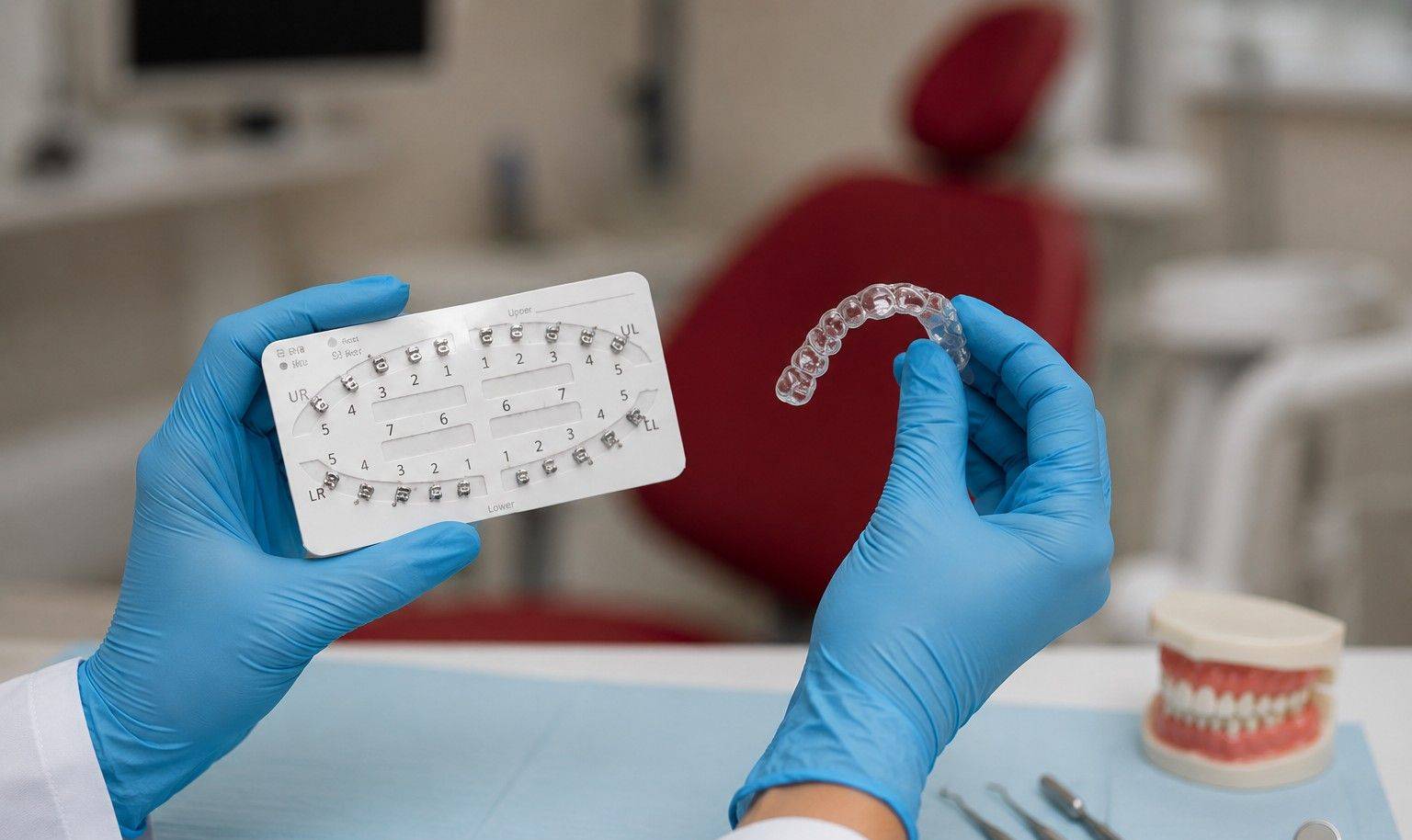
Transparent braces correct misaligned teeth and bite issues using less noticeable materials than traditional metal braces. Clear plastic aligners, tooth-coloured ceramic brackets, and lingual brackets placed on the inner surface of the teeth are the three approaches used in transparent orthodontic treatment.
Transparent braces are available as three main treatment options: Clear Aligners, Ceramic Braces, and Lingual Braces. The most appropriate choice depends on the type of tooth movement required, bite condition, treatment complexity, oral hygiene, and individual treatment needs.
Clear Aligners: Transparent Removable Orthodontic Treatment
Clear aligners are custom-made, transparent plastic trays that gradually reposition teeth into the required alignment. A new set of aligners is typically worn every one to two weeks according to the orthodontist’s treatment plan.
1) Treatment Process
Treatment begins with a 3D digital scan of the teeth and bite. The scan is used to create a customised series of aligners, with each set making specific adjustments to reposition the teeth throughout the treatment period.
2) Clinical Applications
Clear aligners are commonly recommended for mild to moderate crowding, spacing, and selected bite corrections. Because the aligners are removable, patients can remove them during meals and maintain regular brushing and flossing routines.
3) Patient Considerations
Clear aligners are suitable for both teens and adults when the treatment is clinically appropriate. They must be worn for approximately 20 to 22 hours each day as recommended by the orthodontist. Wearing the aligners for fewer hours than advised may slow treatment progress and increase the overall treatment duration.
Ceramic Braces: Less Visible Fixed Orthodontic Treatment
Ceramic braces are fixed orthodontic appliances that use brackets and wires to correct tooth alignment. The brackets are made from tooth-coloured or clear ceramic material, making them less noticeable than traditional metal braces while providing controlled tooth movement throughout treatment.
1) Treatment Process
Ceramic brackets are attached to the front surface of the teeth and connected with an orthodontic wire. The wire is adjusted during regular appointments to create the required tooth movements and improve alignment. Since the braces remain attached during treatment, there is no need to remove or replace them between appointments.
2) Clinical Applications
Ceramic braces are used for different alignment concerns, including moderate to complex crowding, spacing, and bite corrections. As a fixed orthodontic treatment, ceramic braces provide orthodontists with precise control over individual tooth movements in cases that require detailed adjustments, such as closing larger gaps, correcting severe crowding, or managing complex bite problems.
3) Patient Considerations
Ceramic braces are suitable for teens and adults requiring fixed orthodontic treatment with a less noticeable appearance. They are also considered by patients who prefer a treatment option that does not require daily removal and replacement of an orthodontic device.
Lingual Braces: Invisible Fixed Orthodontic Treatment
Lingual braces use brackets and wires placed on the inner side of the teeth to correct alignment. Unlike traditional braces that are attached to the front surface, lingual braces remain out of sight when the patient smiles or speaks.
1) Treatment Process
Each lingual bracket is customised to match the shape of the tooth surface where it is placed. The orthodontic wires are adjusted during follow-up visits to create the required tooth movements, similar to other fixed braces.
2) Clinical Applications
Lingual braces can be used for different alignment concerns, including crowding, spacing, and bite corrections. They provide a fixed orthodontic approach while keeping the braces less noticeable from the front.
3) Patient Considerations
Lingual braces are considered by adults who prefer an orthodontic treatment option with minimal visible appearance. Since the brackets are placed on the inner side of the teeth, some patients may need time to adjust to changes in tongue comfort and speech. Maintaining proper cleaning around the brackets is also important during treatment.
What Can Transparent Braces Correct?
Transparent braces can address different types of tooth alignment and bite concerns. Clear Aligners, Ceramic Braces, and Lingual Braces may be recommended depending on the condition and treatment requirements.
• Teeth Gap (Spacing) – Small to moderate gaps between teeth can be corrected with clear aligners in suitable cases. Larger or multiple gaps may require ceramic or lingual braces for more complex tooth movements.
• Crooked or Crowded Teeth – Mild crowding can be corrected with clear aligners. Cases involving overlapping or rotated teeth may require fixed orthodontic options such as ceramic or lingual braces.
• Crossbite – When the upper and lower teeth are not aligned properly during biting, ceramic or lingual braces may be recommended for correction. Mild crossbite cases may also be treated with clear aligners depending on the orthodontic assessment.
• Open Bite – A gap between the upper and lower front teeth when biting can be treated with any of the three transparent braces options in suitable cases. More complex open bite conditions may require fixed braces for consistent tooth movement.
• Deep Bite – When the upper front teeth cover the lower teeth more than normal, treatment depends on the cause, including tooth position or jaw development. Ceramic and lingual braces can provide detailed tooth movement for deep bite correction, while clear aligners may be considered for milder cases.
The recommended treatment approach depends on the severity of the condition and whether the concern involves tooth position, jaw structure, or both. A clinical evaluation is required to identify the most appropriate option for achieving stable treatment results.
Choosing the Right Transparent Braces Option
There is no single transparent braces option that is suitable for every patient. The right choice depends on:
• Severity of the alignment issue – Clear aligners are commonly used for mild to moderate cases, while ceramic and lingual braces may be recommended for more complex tooth movements.
• Daily routine and treatment commitment – Removable aligners need to be worn for the recommended hours each day to support treatment progress. Fixed options like ceramic and lingual braces provide orthodontic correction without requiring daily placement or removal.
• Visibility preference – Ceramic braces have tooth-coloured brackets that make them less noticeable compared to metal braces. Lingual braces are placed on the inner side of the teeth, making them not visible when looking at the front of the smile. Clear aligners are transparent trays that are less noticeable during regular conversations and daily interactions.
• Comfort with fixed or removable options – Some patients prefer removable aligners because they can take them out while eating and during oral hygiene routines. Others prefer fixed braces because there is no need to remember to wear and remove the appliance regularly.
• Age and lifestyle – Treatment choice may vary based on age, daily routine, and orthodontic requirements. Teens and adults may have different needs when selecting between removable and fixed orthodontic options.
A detailed orthodontic evaluation, including a clinical examination and digital scans or X-rays, is required to determine the most suitable transparent braces option based on the patient’s dental condition and treatment needs.
Orthodontic Treatment Options at Al Salam Health
At Al Salam Health, Al Ain, our orthodontic specialists evaluate each patient’s tooth alignment, bite, oral health, and treatment requirements before recommending the most appropriate orthodontic treatment.
We provide:
- Clear Aligners / Invisalign
- Ceramic Braces
- Self-Ligating and Damon Braces
- Functional Appliances
Treatment recommendations are based on the type of alignment concern, bite condition, treatment complexity, age, and individual patient requirements to support appropriate orthodontic care.
For appointments or enquiries, call +971 3 764 6510 or email newalsalam@alsalamhealth.ae.